DjangoBooks.com
Welcome to our Community!
Categories
- 19.6K All Categories
- 1.2K General
- 502 Welcome
- 60 Archtop Eddy's Corner
- 157 CD, DVD, and Concert Reviews
- 389 FAQ
- 27 Gypsy Jazz Italia
- 31 Photos
- 211 Gypsy Picking
- 21 Unaccompanied Django
- 15 Pearl Django Play-Along Vol.1
- 20 Gypsy Fire
- 47 Gypsy Rhythm
- 1.4K Gypsy Jazz University - Get Educated
- 135 Gypsy Jazz 101
- 246 Repertoire
- 243 History
- 713 Technique
- 51 Licks and Patterns
- 6 Daniel Givone Manouche Guitare Method Users Group
- 20 Eddie Lang Club
- 1.4K Gypsy Jazz Gear
- 849 Guitars, Strings, Picks, Amps, Pickups and Other Accessories
- 501 Classifieds
- 55 Recording
- 66 Other Instruments
- 18 Violin
- 5 Mandolin
- 23 Accordion
- 7 Bass
- 13 Woodwinds
- 386 Gypsy Jazz Events
- 160 North America
- 128 Europe
- 98 International
In this Discussion
Who's Online (0)
Today's Birthdays


Disappointed with my fret dressing
 littlemark
New
littlemark
New
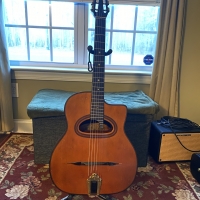
I finally did a fret level and dressing on my Tremblay. I did it myself. (Maybe that's the problem).
I had to lower the frets quite a bit to level them probably.
Now the the guitar feels weak and lifeless. I feel I can't hammer the strings and play loud like a usually do.
I think there is still lots of fret height left (especially compared to my other guitars).
I'm just so disappointed. Band practise last night was a bit of a challenge. :(
Thoughts? Suggestions?
I know there low E buzzes now, because the zero fret is lower. Is it possible the nut is too high and not putting enough pressure on the strings?





Comments
Raise the zero fret to troubleshoot. Use a slice from the soda can as a shim. Which will probably zap the highs (if you can a high quality SS in 0.2-3mm thickness then it wouldn't). But it'll change the feel, hopefully back to what you had before. If it does, then replace the zero fret.
Not knowing you or your skills my first advise is STOP. Take your guitar to a luthier.
Ha, well, I assumed he knew what he's doing. I've never done it but if you have the tools and you're a handy person, it can be done. I think leveling is the most important part of the job, that's where it's crucial to get it right.
I destroyed a couple of cheap guitars learning to do fretwork. I once bought a chinese scalloped strat neck that was crooked and refretted it like 5x before the scallops were pretty much gone. It ended up in the trash. I worked on a lot of medium crappy stuff before I pronounced myself competent.
Taking it to a luthier before you do anything else is probably a good bet.
At this point the genius tools for fret work for me are the stewmac Fret Rocker, fret kisser and then a short fret bar. But fretwork remains for me one of the hardest things to do perfectly. The repair guys who do it constantly have really good chops but I do it maybe 7x a year if that. I have a lot of notes and have to remind myself each time what the routine is.
Obviously a fret dress is simpler then a refret but a lot of the same issues are involved. And you might have some twist in the neck or something that makes everything impossible and that becomes really difficult both to measure and then to account for.
The most important thing for me with any of this stuff is pretty simple: when I fuck up, walk away for as long as it takes to forget about it and then think of a plan and research before I do anything else. It is really hard for me to do this and I fail sometimes, but it is 100% guaranteed that after I do a medium level fuckup, if I don't get out of the shop, I will commit a 5x greater fuckup trying to rush to fix it.
Definitely possible that the strings are stuck in the nut and not hitting the zero fret if you lowered them a lot. I have tried a zero fret the same size as the rest of the frets and one the next size up, both can work. So you can make your zero fret in the same plane as the rest of your frets but if you do it sort of necessitates that you make the rest of your frets absolutely perfect. If your zero fret is a tiny bit higher it gives you a little buffer for the rest of the frets but to me it takes away a bit of the advantage of the zero fret.
Anyway, apologies if that's not helpful. For me fretwork is hard. There are a lot of tools involved for me, a really good straightedge, feeler gauges, fret bars (these things are genius), the fret kisser (also great), fret files, etc etc.
I don't know if it was helpful or not but it nudged me to go at it again.
I added more fall away, and polished a little better. It sounds much better.
I don't have a fret kisser or shot bar. But I can see those are useful.
When you say fret bar, do you mean the under string one from stewmac or just a regular bar.
Getting stuff from stewmac is a pain ($) in Canada.
That's what I was gonna ask earlier, did you simulate string tension when you did it first time?
Under string. You can make one out of a piece of aluminum angle iron. You need adhesive sandpaper or you can use spray adhesive. I think mine has 400 on it. I basically only use the short one. I think Evan Gluck sort of invented them.
You definitely have to have a fret rocker, probably better to buy rather than make one.
And yeah I try to do everything under tension, that's why the fret bar is so good. For me I'm almost always doing a neck I machined so I'm starting out from an easy place but either way, doing it without the strings you don't really know what the neck will do.
Basically I'm looking at the general line of the frets first, trying to correct things in general with the truss rod and get the board flat, if it's really bad, flattening the whole board with a long fret bar but ideally using the fret rocker to find the problem spots and gently correct that with the short bar.
The fret bar/under string stuff to me is 85% as good as a plek if you know what you're doing. Which makes it 100% as good as needed, I think. It takes away a lot of the need for more elaborate tools like the Erlewine jig. At least I think so. Plenty of people would argue that. For doing really effed up necks you might have to pull out more stops.
If you're interested in getting better at repair work in general, Ted Woodford videos are a really excellent starter. I did a harmony rebuild a while back based on his series and I learned a shitload.
And I'm not a repairman at all, so you can ignore all of the above. It's much easier to fret a new neck then to fix an effed up old twisted one.
I'll get an under string bar.
That will certainly be useful for the DiMauro.