DjangoBooks.com
Welcome to our Community!
Categories
- 19.6K All Categories
- 1.2K General
- 500 Welcome
- 60 Archtop Eddy's Corner
- 157 CD, DVD, and Concert Reviews
- 389 FAQ
- 27 Gypsy Jazz Italia
- 31 Photos
- 211 Gypsy Picking
- 21 Unaccompanied Django
- 15 Pearl Django Play-Along Vol.1
- 20 Gypsy Fire
- 47 Gypsy Rhythm
- 1.4K Gypsy Jazz University - Get Educated
- 134 Gypsy Jazz 101
- 242 Repertoire
- 242 History
- 712 Technique
- 51 Licks and Patterns
- 6 Daniel Givone Manouche Guitare Method Users Group
- 20 Eddie Lang Club
- 1.4K Gypsy Jazz Gear
- 849 Guitars, Strings, Picks, Amps, Pickups and Other Accessories
- 501 Classifieds
- 55 Recording
- 66 Other Instruments
- 18 Violin
- 5 Mandolin
- 23 Accordion
- 7 Bass
- 13 Woodwinds
- 385 Gypsy Jazz Events
- 160 North America
- 127 Europe
- 98 International
In this Discussion
Who's Online (1)
-
 12:54PM
Today's Birthdays


Stimer's history (short)
 jazzz
NetherlandsNew Selmer 505
jazzz
NetherlandsNew Selmer 505
A short story I wrote on Stimer pickup history, based on Nicolas Pellet website (Jean Guen's grandson) Christian's website (Yves Guen's son) and Christian's Youtube interview. I've tried to compress all the history into all major milestones to get an idea on the company's direction.
As guitarists pushed for more volume and a clearer, more controllable sound than microphones and early piezo and contact solutions could deliver, French radio engineer Jean Guen and his brother Yves Guen began experimenting with magnetic pickup technology.
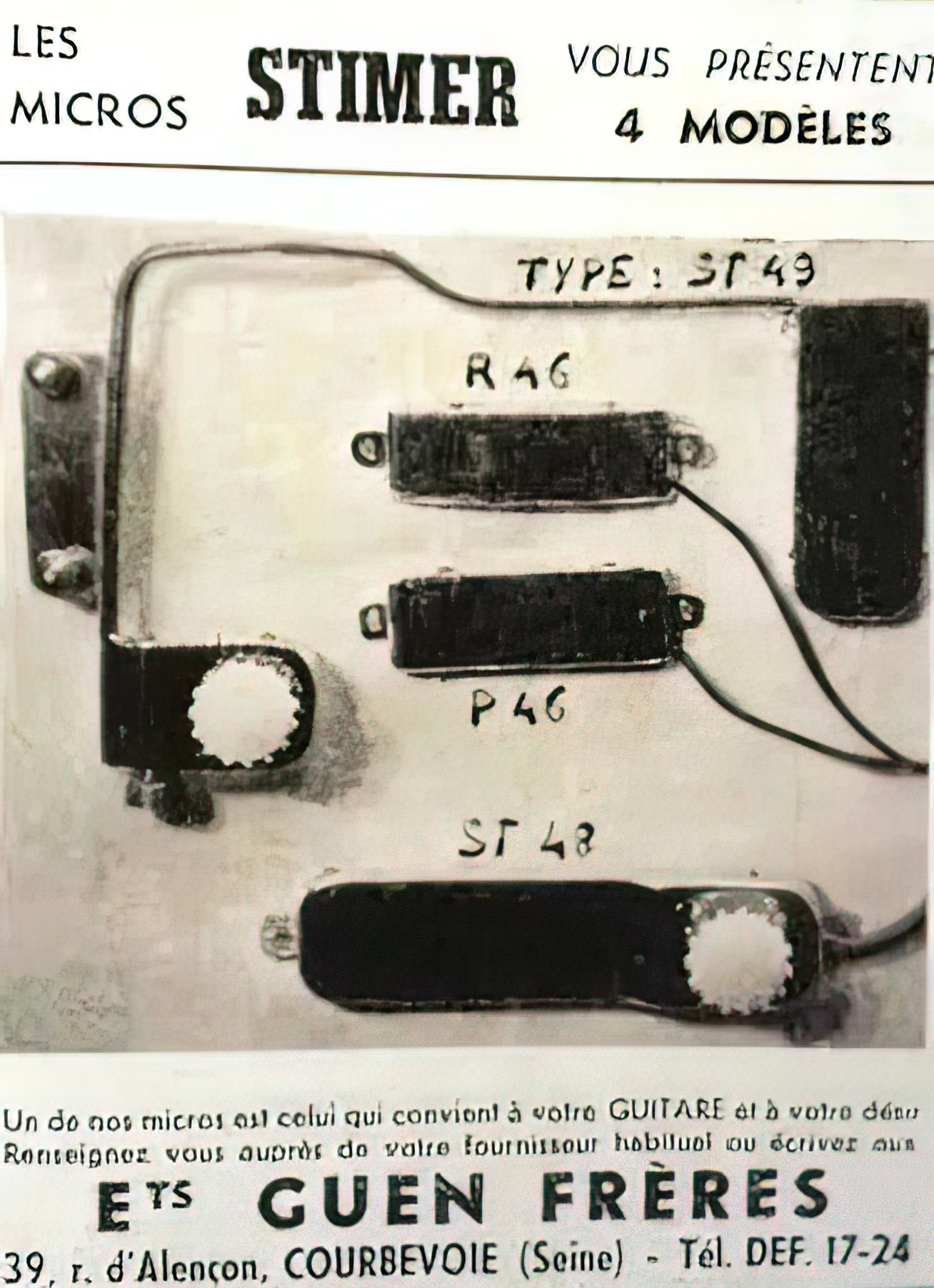
In 1945, Jean opened a small radio workshop at 39 rue d’Alençon in Courbevoie. Early experiments included the P46 and R46 pickup prototypes.
A major turning point came with Django Reinhardt. In 1947, after his 1946 US tour, Django asked Yves to look into creating a pickup that could give him a more electric voice while still playing his acoustic Selmer-Maccaferri guitar. Django’s request helped shape the direction of Stimer.
Their collaboration evolved into the first industrial, mass-produced Stimer pickup, the ST48, introduced in 1948. Using a Stimer ST48 paired with a Stimer M12 amplifier, Django became the most influential early ambassador for the Stimer sound, helping popularize the amplified tone heard in his later recordings.
In 1951, Stimer introduced a no-drill alternative for guitarists who wanted amplification without modifying their instrument, the S51. It refined the concept into the iconic “monkey on a stick” rod system: a clamp anchors behind the bridge while a sliding rod suspends the pickup above the top. This also allows positioning between neck and bridge to shape response and harmonics. The design is compatible with most archtops and Selmer-style acoustic guitars.
In 1958, the Guen brothers ended their collaboration. Jean pursued other projects in French electronics and musical gear under Garen and Shade, while Yves retained the Stimer business and continued production until his death in 1986 and then continued by his son Christian until 1996. Pickups produced after the brother's split can be recognized by the “Yves Guen” trademark added in small print to the Stimer hardware.
Decades later, the Stimer sound continues to inspire builders and players. Modern reissues and faithful replicas remain a staple in gypsy jazz for that bright, direct attack and unmistakable “Django-era” color, with its unique and vibrant tone.
In 2014, Christian resumed production, now under his father's name Yves Guen. The Stimer name is no longer mentioned on his pickups, since the Stimer trademark is currently registered by another company.












Comments
Do we know if the design of the pickup itself changed at all between the 48 and 51 models? I always thought they had a different sound.
According to Christian the only difference is that the S51 has a separate volume control instead of being integrated. However, every Stimer was assembled by hand where the coil was spun by hand, so all Stimers differ in sound individually.
I've had over a dozen vintage Stimers so far and I can confirm this.
Thank you, that makes sense. I especially liked the S51 sound of Dupont reissues for some reason. I thought it had more chime-y sound to it. Only years later I learned about the controversy of Dupont registering expired Stimer trademark. That made me less of a fan.
Hi,
Jean Guen actually opened his worshop in 1946 with one of his friends, Paul Pieretti. At that time, Yves Guen was working in a completely different field since he was a vegetable merchant back then. He joined his brother Jean around 1948, maybe in the end of 1947.
Sorry to ruin the "legend" but according to Jean Guen, the ST 48 wasn't specially designed for Django, he just gave him the ST 48 (and the M12 amp) at the end of 1950 because it was the only industrial Stimer pick-up available at that time. Moreover, there's no document (photos, adverts...) proving that Django used the ST 48 before 1950. By the way, the first Stimer advert mentioning Django Reinhardt published in the French magazine "Jazz Hot" dates back to Februar 1951 while Stimer started publishing in this magazine in April 1949.
Thanks. I'm just summarizing the account by Christian, Yves Guen son. Do you think Christian is wrong?
Christian states that the atelier opened in 1945:
Christian also states that Yves connected with Django in 1947 to inspire the making of ST48, stated both on his website and in his Youtube interview:
Your account is more in accordance by the telling of Nicolas Pellet (Jean Guen's grandson), which can be found on https://stimer-garen.fr
Both brothers did separate ways in 1957. I wonder what for.
Yes, Christian is wrong on some points or at least he embellishes reality (probably for commercial reasons) and unfortunately is not very accurate about the first period of the Stimer history. But he is without a doubt a great electronics specialitst.
According to the French craft and trade registers, Jean registered a radio construction and repairer company in April 1946 which was located at 39, rue d'Alençon in Courbevoie. Jean lived in the workshop for about 8 years. His brother Yves began an itinerant vegetable business in September 1946.
When Jean started his business, he had an associate who wasn't yet his brother Yves but a guy named Paul Pieretti. When Jean created Stimer, Yves hadn't yet joined the company.
The reason of the split is quite fuzzy. According to Jean, this was Yves choice to stand on his own feet. Maybe they had a personal disagreement, I don't know... However, Jean kept commercial relations with his brother since he regularly sold him Garen and Shade amps (which were two other brands that he created after the split) that were renamed "Stimer". For example, the 70s Clearwater model that you can see on the Christain website is probably a Shade model restamped "Stimer".
Jean could have started a company in 1945 to have it registered later in 1946, so that depends on your definition of the start of a company. Christian seems to be pretty certain about the year 1945, it's also engraved on his Yves Guen hardware.
So what makes you so certain Christian is wrong about the history and Nicolas isn't?
Ok, I remove my mask. I'm Nicolas Pellet, Jean Guen's grandson. I wanted to remain discrete but your question is legitimate and obliges me to reveal who I am.
My purpose is to tell an accurate story of Stimer and the work of my grandfather. Everything I state on my website is supported by official documents.
I'm sorry to say that Christian Guen's website is full of mistakes, vagueness and untruths. On top of that, he completely overshadows his uncle Jean while the company and the Stimer brand were his property until the break-up in 1958.
My mother Laurence Guen and I have nothing to sell, we just want to restore the honor of my grandfather which has been undermined by Christian's statements.
I guess that Christian engraved the year 1945 on his pickup because of its symbolic dimension, 1945 speaks to everybody. But there is no reality behind that.
I'm pretty sure that the story about the creation of the ST 48 involving Django contribution is a legend built from scratch, a marketing trick, a "fool trap". But it's up to Christian to prove us the contrary.
Posting in an epic thread.
Okay thank you Nicolas for clarifying, it's good to know your perspective.