DjangoBooks.com
Welcome to our Community!
Categories
- 19.6K All Categories
- 1.2K General
- 502 Welcome
- 60 Archtop Eddy's Corner
- 157 CD, DVD, and Concert Reviews
- 389 FAQ
- 27 Gypsy Jazz Italia
- 31 Photos
- 211 Gypsy Picking
- 21 Unaccompanied Django
- 15 Pearl Django Play-Along Vol.1
- 20 Gypsy Fire
- 47 Gypsy Rhythm
- 1.4K Gypsy Jazz University - Get Educated
- 135 Gypsy Jazz 101
- 246 Repertoire
- 243 History
- 713 Technique
- 51 Licks and Patterns
- 6 Daniel Givone Manouche Guitare Method Users Group
- 20 Eddie Lang Club
- 1.4K Gypsy Jazz Gear
- 849 Guitars, Strings, Picks, Amps, Pickups and Other Accessories
- 501 Classifieds
- 55 Recording
- 66 Other Instruments
- 18 Violin
- 5 Mandolin
- 23 Accordion
- 7 Bass
- 13 Woodwinds
- 386 Gypsy Jazz Events
- 160 North America
- 128 Europe
- 98 International
In this Discussion
Who's Online (0)
Today's Birthdays


Need Serious Help on Technique
 luciotheunknown
New
Hey guys, I'm completely new here and am looking for some help. I am a student based in Montreal, Canada picking trying to pick up gypsy jazz as I absolutely love the genre. I've listened to plenty of Django over the years and have mustered up a very shoddy version of Minor Swing and a little bit of When Day Is Done. The problem is I learnt these songs with normal technique and haven't adopted the floating hand technique. I've scoured youtube and have had some success in learning it but have some general questions:
1) Do I use the pointy bit of my pick or the side of my pick or the back of my pick? I can't exactly identify how players are holding it in the first place as the picks seem pretty rounded.
2) Also to do with picks, is it absolutely essential I have a thick pick? I am using a 1.2mm purple Alice pick.
3) How do I strike the string with a rest stroke while keeping a support finger on the body? When my hand moves laterally my finger wants to move with it off the body.
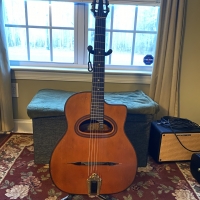
4) I am using a 100 dollar acoustic guitar and it sounds a bit wirey - is it worth investing in a gypsy jazz guitar?
5) Do I have to learn rhythm first before going on to melodies?
6) Does anybody know any teachers in Montreal/online teachers to help me get started.
Sorry for the onslaught of questions, just feel a bit lost with the different views of different people online, some direction would be nice. How I usually learn music is a put a track in audacity, slow it down, and learn the notes - this seems a little more involved but I really want to learn.
Any help would be much appreciated,
Lucio





Comments
A few thoughts:
1) You don't need a massively thick pick. Stochelo Rosenberg seems to use a 1.8mm pick.
I've practiced gypsy picking on an ordinary acoustic (Taylor guitar): Gypsy Jazz etude (All of Me)
2) Don't anchor your fingers or wrist. You can slide your fingers along the strings or guitar but do not push them down. In fact I have a small callous on my little finger of right hand that keeps touching the strings, but do not push them down and make them your anchor point. Don't keep a little finger on the body or smth similar. Your arm rests on the guitar.
3) You don't have to learn rhythm first imo. I kept going back and fourth between alternate picking and economy picking until I found that the so called "gypsy picking" was the most comfortable of them all. At least for me. It's not that suitable for styles like rock or metal but for jazz it just suits me.
4) Buying a gypsy guitar helps but just as I posted before, I've practiced and played before on an ordinary acoustic and everything was fine. The main thing that changed when I got a gypsy guitar was that the distance of strings to the body aggrevated. You want a gypsy guitar at some time but you can learn all the basics and practice on your ordinary acoustic.
1) I use the round side of the pick. A lot of players use the purple Dunlop tortex which are cheap and available. I use a 1.3mm Dunlop primetone in the same shape.
2) thickish is probably helpful. But you don't need a monster pick, see above.
3) there's a lot of good gypsy picking tutorials on YouTube. I think Christiaan Van Hemert has a great one. It's a lot of practice. I keep my fingers curled so that the knuckle of my pinky is on the guitar top. And then everything slides with that.
4) I think it is difficult to learn this style effectively with a martin style guitar. The bridge geometry is very different. There are cheap guitars around.
5) you can work on both.
6) Montreal has a pretty good GJ scene. Christine Tassan runs a jam weekly I think. There's like 3 luthiers making great gj guitars in Montreal. I'm trying to move there.....
Thanks guys, very helpful comments
With the gypsy picking, it's likely it will feel weird and stupid but ultimately it is a really good way to make acoustic guitars sound good. .
The Troy Grady interview with Joscho Stephan is very useful. Kind of advanced but worth paying for
Yes, you should definitely use the round side. With thickness I'd recommend a fatter one, at first it may be easier to get better tone than with a very thin one, and it will sound more gypsy-jazzy, too thin of a pick will make the sound have a sort of bluegrassy quality. Its true that most of the greats nowadays use thin picks, but I'm pretty sure it's not what they started with. The reason your fingers lose contact with the board is probably either because your wrist arch angle is not great enough, or that the movement is not exactly how it should be. Ideally you should push through the string, the pick should be slanted, and at the end of picking the note your wrist shouldn't twist upwards.
Don't know if that made sense, I dont think I can exactly put to words what I'm thinking without making a video or something
Edit: I love thick picks and use a 5mm myslef, I think it gives a fatter tone and a more volume
Aside from the very good advice above:
Gypsy Picking is worth the effort, rest stroke going down, basically always start a string with a downstroke. You will not get the sound of this music without this technique.
Learn (at least some!) rhythm, it is possible to be primarily a soloist, but even then you will still play a lot of rhythm. Start with Minor Swing, Minor Blues and some tunes in major (Hungaria, Lady be Good, Daphne). Ideally learn these off of videos of performances for the chord shapes generally, and then play along with the Django Records.
In Montreal find these people: Christine Tassan, Martin Gioani, Tcha Badjo and occasionally Denis Chang (used to live there, sometimes comes back - I think like once a year),
Good luck!
I don't think Martin is still in Montreal but I'm not sure.
There's a great player there who was Dennis's assistant but I can't remember his name. He came to DIJ once a long time ago and has one of Josh's guitars.
You wrote
just feel a bit lost with the different views of different people online
Did you notice how you already have different views in a few comments that have been made?
Which tells you there's no one right answer. Play a lot and see what feels comfortable. A lot of needs to be self discovery.
Rest stroke picking is relatively speaking a must. Among the best of the best you have a range of people using different thickness picks, using main point or round tip etc...
There are also many ways to support your hand while employing a floating wrist technique, try some and see which feels good. Some use pinky, some curl up all of their fingers and support with knuckles etc...
If you can afford a Selmer style guitar, in any budget range, yes a 100%. Can you learn basics on a flat top? Yes. A gypsy guitar will provide you a feedback with its sound (even though the sound can and does vary widely but it'll be more accurate feedback than a flat top) which you can kinda compare with what you heard from people who do it well, and that'll be your own feedback. Same thing when you're recording yourself.
Learn what feels like fun doing. It all depends on your goals but you absolutely need to spend a lot of time on rhythm.
Welcome and good luck!
I'm no expert but would suggest:
Select one video where you like the tone the instructor gets, and you can follow the instructions - and stick to this one video.
Get that 'feeling' of doing it right, what is feels like, and go for that sensation. This is how you learned to walk, ride a bike, etc.
Get to that point where you can self-correct ASAP.
Record yourself and watch and listen to video - are you sticking with the proper technique.
Play slowly and deliberately - play slow enough so that you're surprised if you do it wrong. You get better by doing the technique correctly, not from doing it wrong.
BTW, I try different picks, thin\thick and play the tip and round edge, etc. I find myself gravitating towards phatter picks and playing the tip.
My 2 cents: The downstrokes should indeed end up resting securely on the next string, which happens if you play somewhat "into" the guitar top. Don't "pull your punches" as you hit the string that you are getting the note from; instead, let the next string cushion the motion and even help bounce it back up. (Doesn't apply to the 1st string.)
For upstrokes, it's also very different -- an affirmative flick of the wrist, which is a motion that we don't do in "real life" and that you have to learn.